Naili Conveyor
The advancement of smart manufacturing and intelligent logistics continues, and many manufacturing enterprises, e-commerce cloud warehouses, express delivery sorting centers, and third-party logistics parks have already completed automated upgrades to processes such as warehouse storage, sorting, inventory counting, and outbound dispatch. Systems such as barcode-based inbound receiving, WMS warehouse management, automated sorting, automated storage racks, and AGVs can improve warehouse organization, reduce backlogs and sorting errors, and increase operational efficiency within the warehouse.
However, in-warehouse automation does not mean that the entire logistics chain is operating smoothly. Manual loading and unloading remain common, making end-stage handling a key factor affecting overall efficiency. As the operating speed of upstream systems continues to increase, stoppages, waiting, and repeated manual trips at the loading and unloading end are more likely to become visible bottlenecks.
Why do loading and unloading so easily become efficiency bottlenecks?
Manual loading and unloading are first affected by personnel-related factors. Work speed, skill level, and on-site coordination can all fluctuate. New employees require training, while peak seasons may bring recruitment difficulties and rising labor costs. For factories, cloud warehouses, and logistics hubs with continuous outbound shipments, an unstable loading and unloading rhythm can further affect delivery cycles and on-site management.
Product damage is another key issue that requires attention during loading and unloading. Cartons may become deformed through repeated handling, compression, and transfer, while goods may also be knocked, scratched, or even broken. Products such as food, home appliances, electronic components, and precision instruments have high appearance and quality requirements, making it especially important to reduce the risk of losses caused by manual handling.
Site conditions determine whether a fixed conveying line can actually be implemented. Differences in loading dock height, vehicle compartment depth, and aisle width, as well as the absence of a fixed loading dock, can all increase the difficulty of equipment deployment. For open-air loading and unloading points and sites that need to serve multiple vehicle types, fixed conveyor lines often struggle to cover all operational requirements.
How to choose conveying equipment for different loading and unloading scenarios
Powered telescopic roller conveyors are suitable for continuous heavy-load operations
Factory dispatch, full-container loading, and large-volume cargo transfer typically involve heavy loads, high frequency, and continuous operation. Powered roller lines, powered telescopic roller lines, rubber-covered powered telescopic roller lines, multifunctional powered telescopic roller lines, and truck loading and unloading Powered Roller Conveyor are suitable for the batch conveying of regularly shaped goods and large cartons.
The equipment can use O-ring belt or multi-wedge belt transmission, providing stable operation and strong load-bearing capacity, while also being suitable for long periods of continuous work. By replacing some manual back-and-forth handling with continuous conveying, it can reduce interruptions and waiting during operations, helping factories and logistics parks maintain a relatively steady shipping rhythm.
When the site is damp, dusty, or subject to corrosion-resistance requirements, stainless steel powered roller lines and stainless steel telescopic roller lines are more suitable for this type of environment. Their features include moisture resistance, rust resistance, corrosion resistance, and easy cleaning. For goods that are prone to scratches, such as cartons and finished home appliances, rubber-covered powered roller lines can use flexible rubber covering to reduce impact and wear.
Telescopic belt conveyors and lifting equipment adapt to changes in height
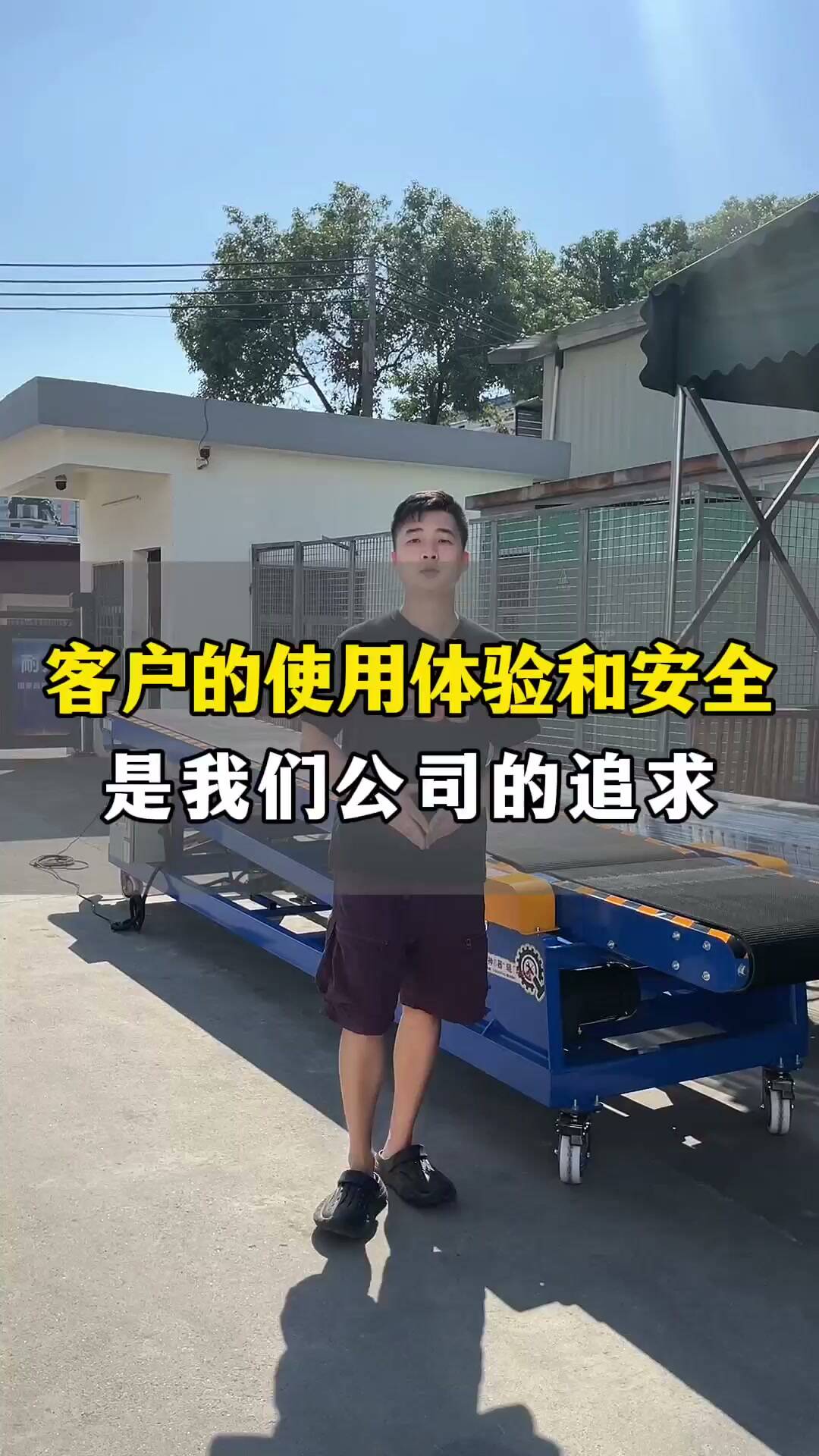
Loading and unloading parcels such as express shipments, small items, bulk goods, and cartons often requires equipment to move flexibly back and forth between different vehicle types and positions. Telescopic belt conveyors, hydraulic Telescopic Conveyor, and telescopic belt conveyor lines offer flexible extension and convenient forward and reverse movement, making them more suitable for the high-frequency transfer of light- and medium-load parcels.
Many on-site efficiency problems are also caused by differences in height. When the heights of loading platforms, floors, and vehicle compartments do not match, manual handling becomes more laborious, and goods are more likely to get stuck or fall. Hydraulic lifting incline conveyors and electric hydraulic lifting conveyors can adjust their height within a certain range, creating smoother conveying connections between warehouses and trucks, and between floors and loading platforms.
Non-powered equipment is suitable for intermittent and temporary operations
For scenarios with limited budgets or intermittent and temporary operations, non-powered equipment can serve as a low-cost option. Non-powered roller lines and non-powered rubber-covered conveying equipment rely on the weight of the goods to make them slide, offering zero energy consumption and maintenance-free operation.
Flexible wheel conveyors and non-powered flexible-wheel unloading equipment are suitable for sorting and irregular sites, offering greater flexibility for turning and diverting. Non-powered chutes, foldable cargo chutes, and vehicle-mounted handling chutes are easy to access, fold, and store, and can be used in small and medium-sized warehouses and temporary loading and unloading points.
System combinations and on-site adjustments determine equipment suitability
Upgrading loading and unloading operations usually requires combining equipment around the complete workflow rather than configuring only a single machine. For example, telescopic roller lines combined with Hydraulic Conveyor can be used for full-truck loading and unloading; flexible-wheel conveyor lines paired with non-powered chutes are suitable for low-cost sorting and transfer; and combining telescopic belt conveyors with lifting equipment can address conveying needs involving greater height variation and more flexible operating positions.
The focus of equipment selection is not simply the number of models, but how well they match the on-site operating conditions. Depending on site dimensions, cargo weight, operating methods, and vehicle size, the equipment length, width, telescopic travel, lifting range, roller material, and transmission method should also be adjusted accordingly. Developing a solution based on site conditions and then configuring equipment according to cargo requirements is usually more practical than directly applying a generic solution.
For truck loading and unloading, the focus of automation upgrades is not simply adding more equipment, but truly connecting the warehouse system with end-of-line operations. Combining flexible conveying equipment, lifting equipment, and non-powered equipment according to the application scenario makes it possible to better meet the actual needs of factories, e-commerce warehouses, logistics outlets, and temporary loading and unloading sites without carrying out large-scale civil construction modifications.