Naili Conveyor
Industry changes are reshaping ground-level loading and unloading
In industries such as manufacturing, warehousing and logistics, e-commerce supply chains, and fast-moving consumer goods distribution, cargo loading and unloading and on-site transfers have always been key links connecting production, warehousing, and transportation. Since entering 2026, changes in the frontline labor structure have continued, with issues such as shortages of workers for physically demanding positions, high employee turnover, and rising labor costs becoming increasingly prominent. Traditional ground-level loading and unloading models centered on manual labor can no longer keep pace with normalized operations and large-scale development.
For many factories, logistics parks, and warehouse sites without dedicated loading and unloading docks, recruitment difficulties, low efficiency, high losses, and elevated risks are no longer isolated issues but comprehensive challenges that directly affect operational rhythm. Against this backdrop, automated, lightweight, and more adaptable logistics conveying equipment is gradually becoming an important choice for companies upgrading their loading and unloading operations.
The main bottlenecks of traditional manual loading and unloading
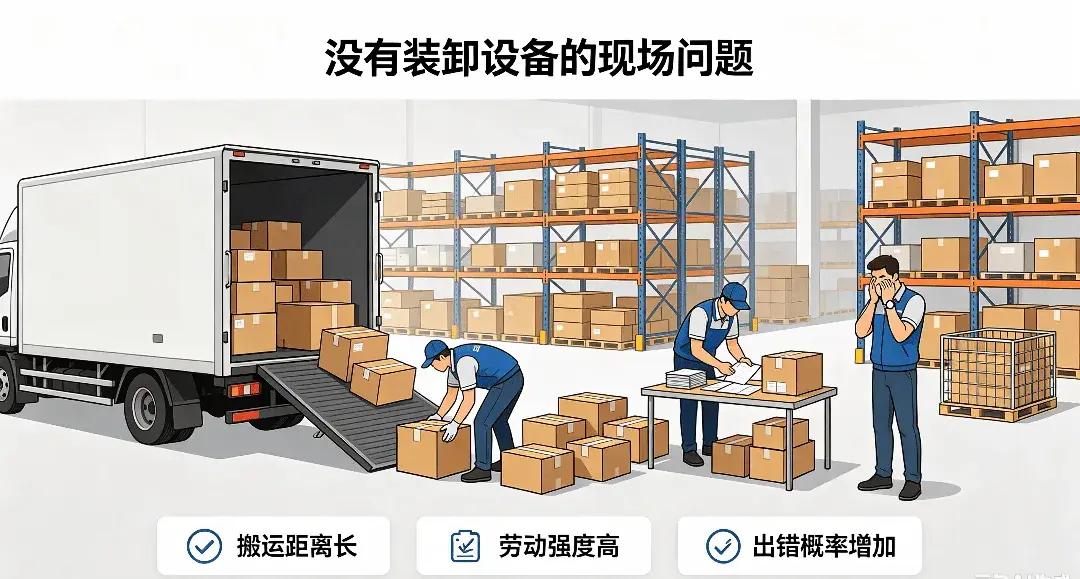
The greatest pressure of manual loading and unloading comes from the dual changes in workforce structure and operating intensity. Loading, unloading, and material-handling positions require considerable physical strength, involve repetitive labor, and are highly demanding. They are not attractive enough to younger workers, and employee turnover in the industry has remained high for a long time. For small and medium-sized logistics companies, workforce turnover not only increases recruitment and management costs but also affects daily production scheduling and shipping rhythms.
When e-commerce promotions, peak production and sales seasons, or concentrated cargo arrivals occur, fluctuations in manual loading and unloading become even more pronounced. Companies often need to hire additional temporary workers, causing costs such as wages, social insurance, meals, and accommodation to rise. At the same time, physical condition, weather, proficiency, and work morale all affect on-site efficiency, making cargo accumulation, delayed transfers, and late order fulfillment more likely.
Safety and product loss are also unavoidable challenges in manual loading and unloading. When there is a height difference between the ground and the truck compartment, workers must repeatedly bend, carry heavy loads, and lift goods, which can cause lower-back strain and joint injuries while also increasing the risk of falls and impact injuries. Without standardized procedures for cargo handling, goods are also more likely to suffer impacts, compression, tipping, and damage, further increasing companies' hidden operating expenses.
Standardized production is the foundation of equipment stability
While the conveying equipment market is growing rapidly, the industry also contains many small processing workshops that compete mainly on low prices. These manufacturers often have limited production conditions, nonstandard processes, and incomplete procedures for inspecting equipment components and finished products, which can easily lead to high failure rates, short service lives, and insufficient stability.
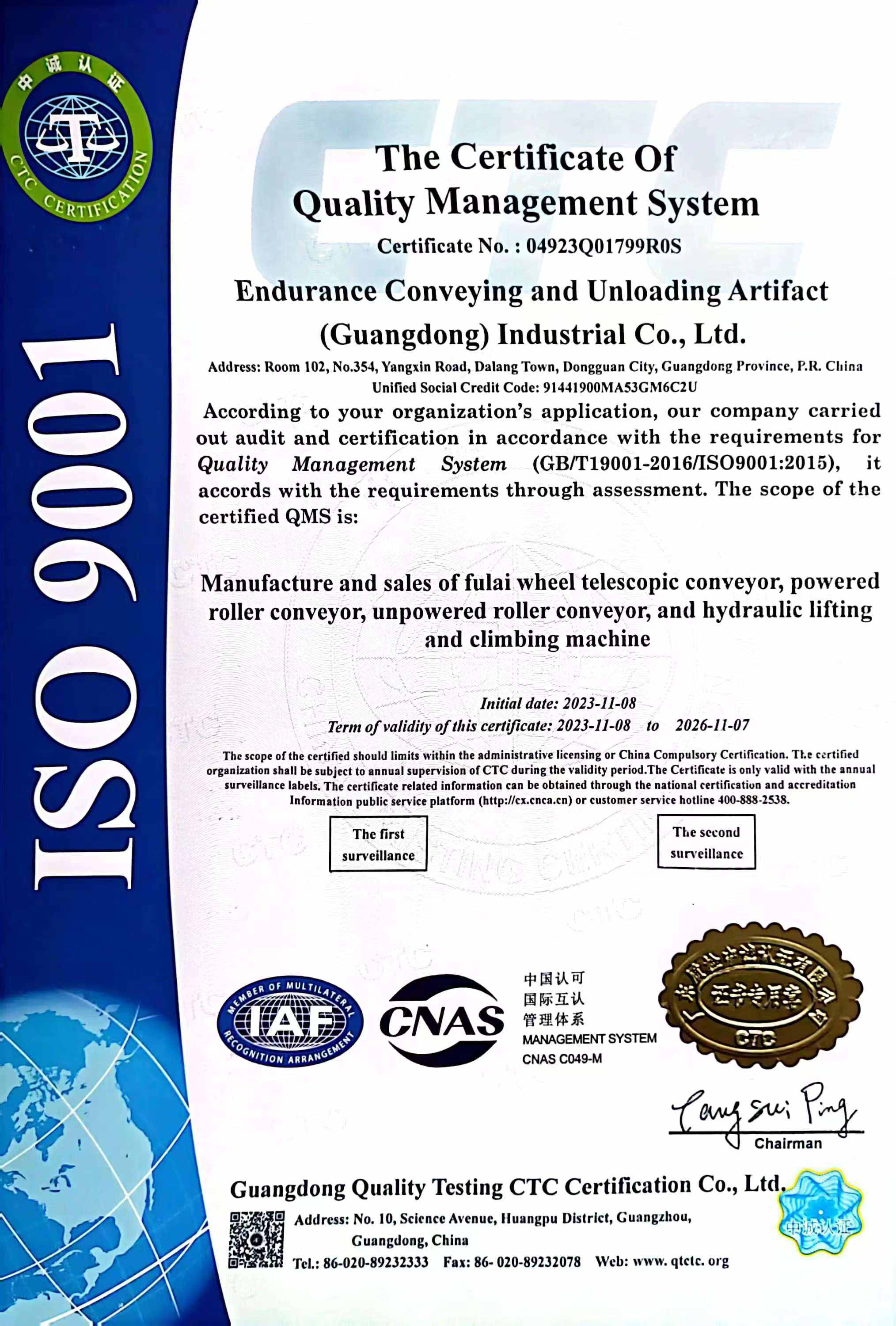
Unlike these workshop-style suppliers, Naili Unloading Artifact (Guangdong) Industrial Co., Ltd. relies on an independent, permanent production site and standardized workshops to establish a complete production chain covering product development, component processing, complete-machine assembly, operational commissioning, and finished-product delivery. The company also implements the ISO9001 international standardized quality management system, incorporating raw-material screening, process inspections, complete-machine testing, and pre-delivery acceptance into a unified process to reduce the risk of nonconforming products entering the market.
In terms of quality certification, the relevant equipment has passed EU CE export certification, indicating that its safety performance, technical parameters, and production processes can meet international export standards. For companies that need to meet both domestic operating requirements and overseas market standards, this provides a clearer foundation in terms of equipment safety, stability, and adaptability.
Application value of powered roller Telescopic Conveyors and hydraulic lifting inclined conveyors
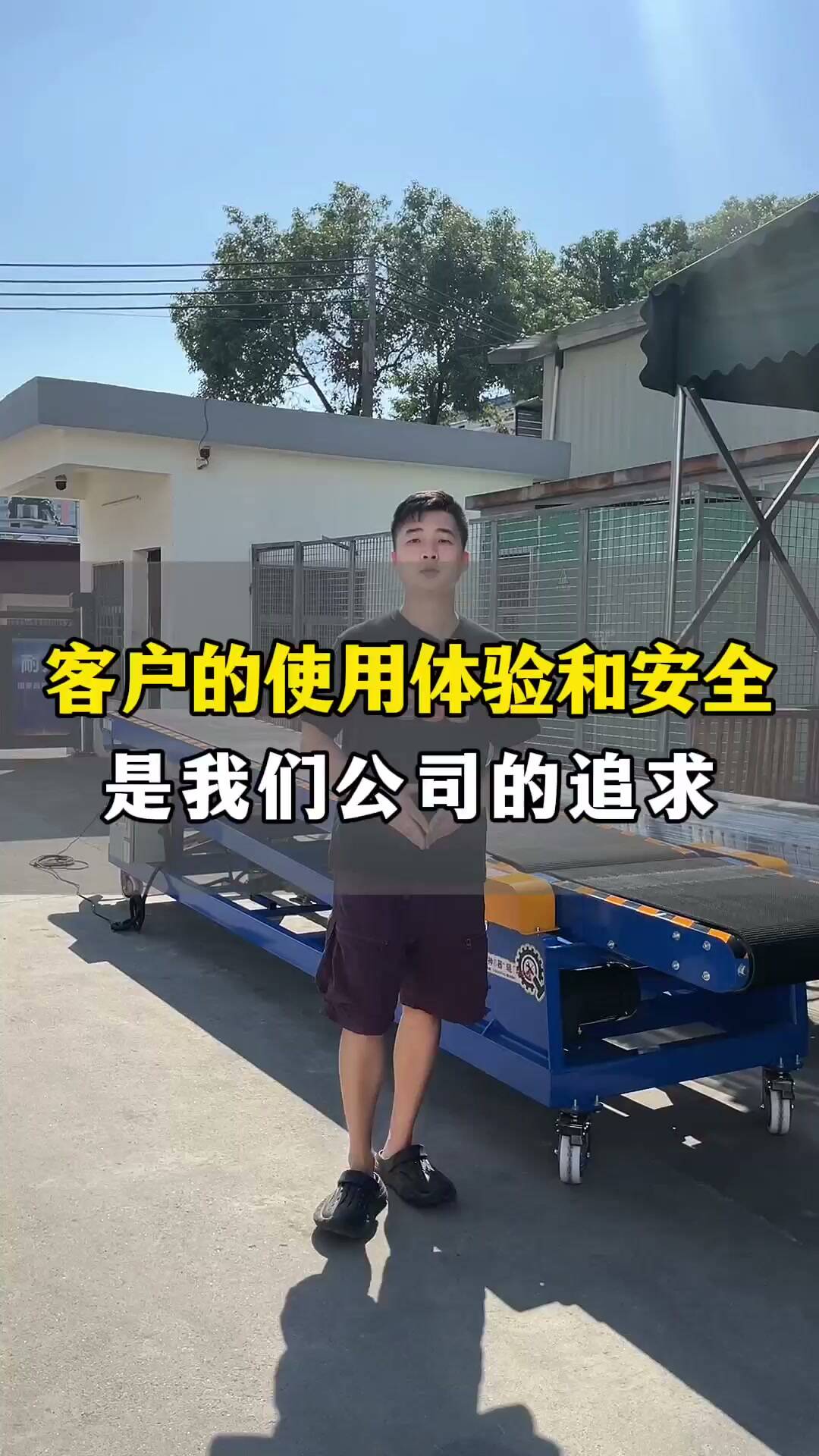
For ground-level loading and unloading scenarios, the powered roller telescopic conveyor line launched by Naili Conveyor, together with a hydraulic lifting and climbing conveyor, forms a complete equipment solution that improves operations across four dimensions: labor, efficiency, safety, and damage reduction. After the equipment is put into operation, goods conveying and transfer between different elevations can be completed through mechanized processes, while workers only need to provide necessary assistance and organization, eliminating reliance on extensive heavy manual handling.
The powered roller telescopic conveyor line is characterized by its extendable design, easy mobility, compact footprint, and ability to adjust according to the vehicle compartment length, operating distance, and site conditions. It can accommodate the continuous conveying of various types of goods, including cartons, luggage and bags, small hardware parts, and daily chemical products. When used with a hydraulic lifting incline conveyor, it can better handle the height difference between the ground and the vehicle compartment, reducing inefficiencies caused by manual climbing, lifting, and handling.
In terms of actual results, this equipment solution helps improve loading and unloading turnover efficiency, reduce goods accumulation and shipping delays, and lower the likelihood of goods being bumped, crushed, or damaged. Compared with traditional manual operations, loading and unloading turnover efficiency can increase by 3-5 times, making it easier for businesses to maintain stable order fulfillment during peak seasons.
A practical upgrade solution for small and medium-sized enterprises
For most small and medium-sized enterprises, logistics upgrades do not necessarily require the immediate implementation of a large intelligent warehousing system. A lightweight complete equipment solution centered on a powered roller telescopic conveyor line and a hydraulic lifting incline conveyor requires less investment, can be deployed more quickly, and is simpler to operate and maintain. It is better suited to high-frequency scenarios such as flat-ground loading and unloading, workshop interfacing, internal warehouse transfers, and the rapid loading and unloading of trucks and vans of different sizes.
As logistics supply chains continue to evolve toward greater precision, intelligence, and standardization, mechanized upgrades to last-mile loading and unloading operations will become a more common choice. For businesses, conveying equipment that can be deployed quickly, operate reliably, and adapt to different scenarios is becoming an important tool for improving efficiency, controlling costs, and reducing risks.