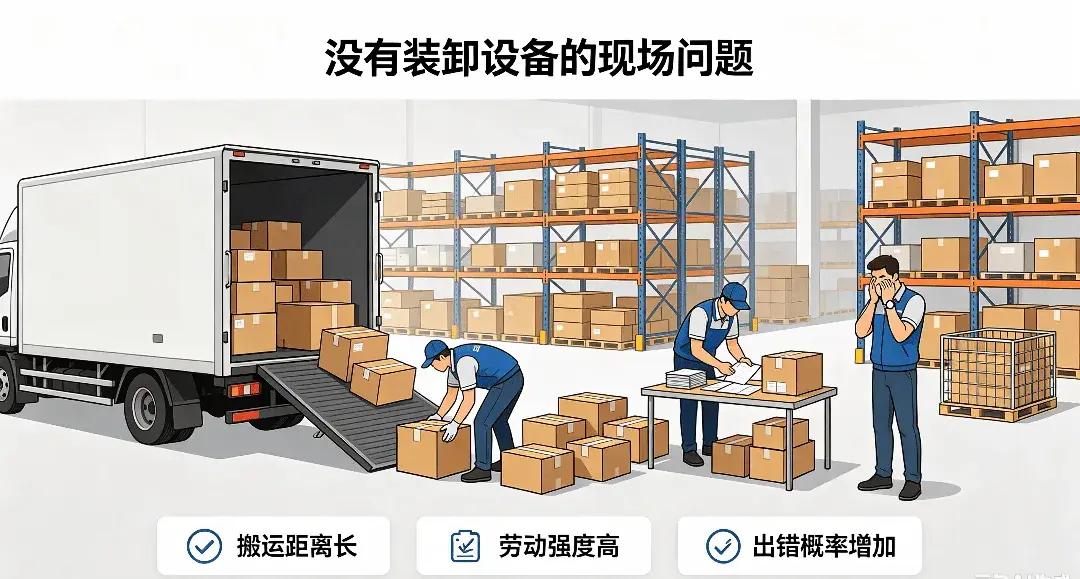
In the daily operations of manufacturing and e-commerce logistics, truck loading and unloading is often the most labor-intensive and highest-risk stage. Long-term reliance on manual handling not only results in low efficiency and higher damage and loss of goods, but also continuously squeezes profit margins through labor costs. With the growing adoption of automated conveying equipment, telescopic Powered Roller Conveyors, hydraulic lift-and-incline conveyors, and telescopic belt conveyors have become the three most widely used types of unloading equipment on the market.
However, many warehouse managers and procurement managers are unclear about the distinctions between machine types and place orders based solely on quotations. This often results in equipment that does not match the site, vehicle types, or goods, wasting budget and affecting capacity. Drawing on implementation experience from various factories, distribution centers, and cloud warehouses in the Pearl River Delta, the following sections break down the features, applicable scenarios, and combination strategies of these three types of equipment, making it easy for warehouse supervisors, factory procurement teams, and industrial park operators to compare and reference directly.
Standard loading dock scenarios: telescopic Powered Roller Conveyors are better suited to neatly packed boxed goods
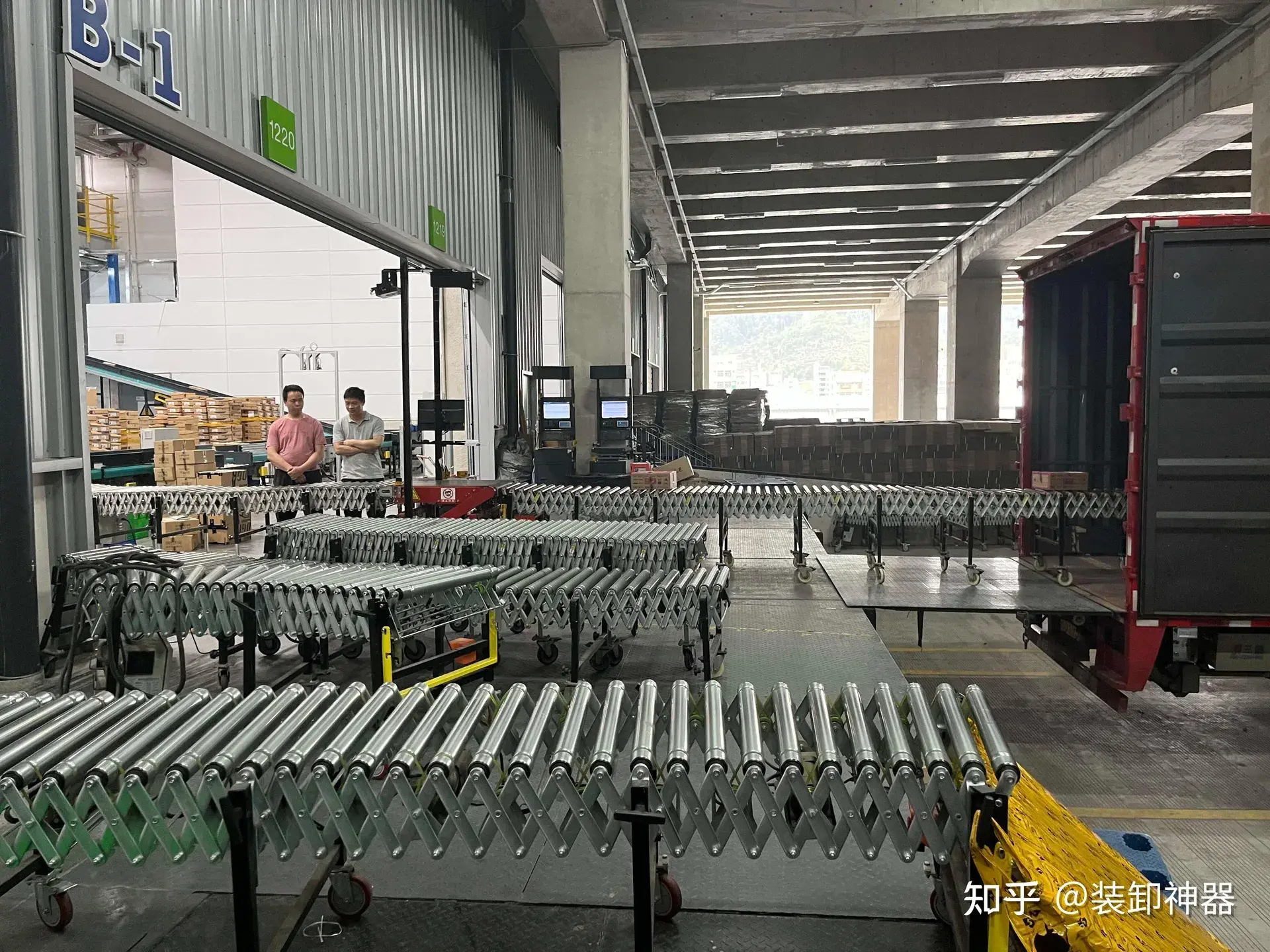
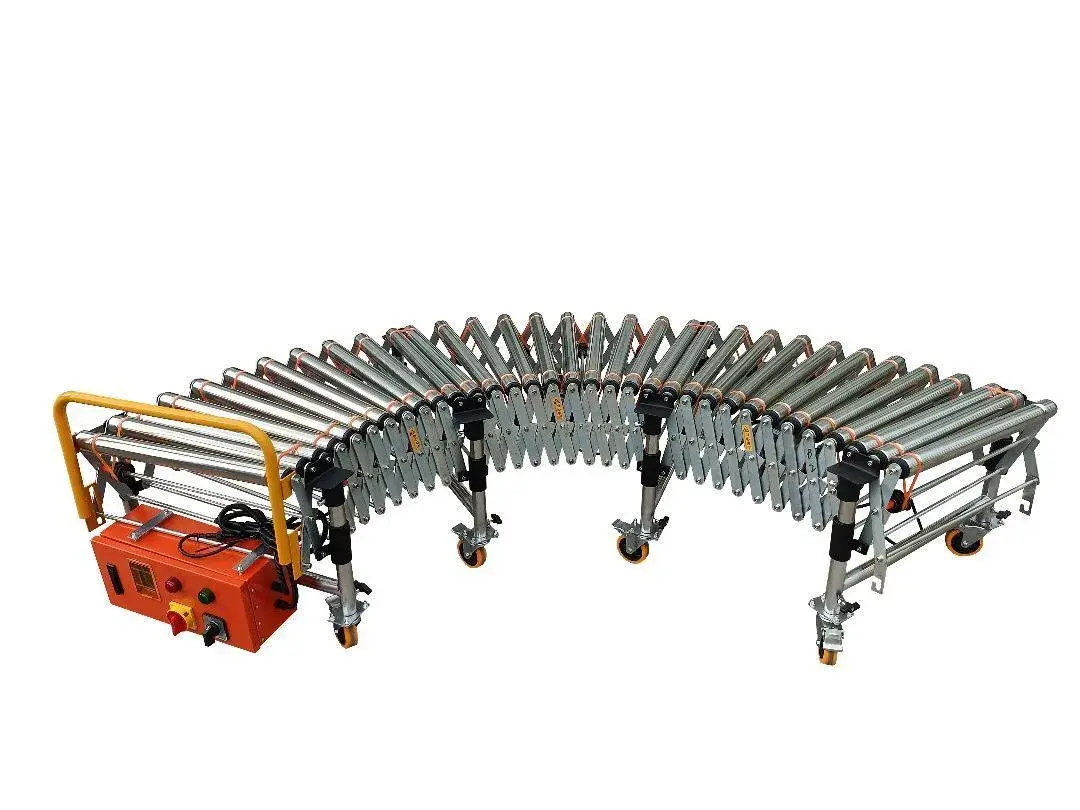
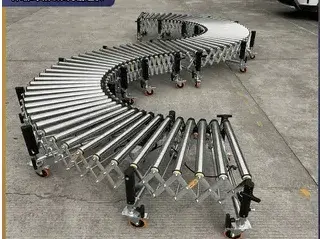
Telescopic Powered Roller Conveyors are designed for scenarios with standard loading docks. Their multi-stage telescoping structure extends directly into the vehicle compartment and can accommodate 4.2-meter light trucks, 9.6-meter box trucks, and 13-meter semi-trailer containers. The conveyor surface can be flush with the loading dock and vehicle floor, enabling level loading and unloading of the entire vehicle. After operations are complete, the conveyor can retract back into the warehouse without permanently occupying passageway space.
Common equipment widths include 500mm, 600mm, and 800mm, while 1000mm and 1200mm widened versions can also be customized for heavy full-pallet loads. Roller configurations vary according to the goods: materials that are prone to slipping, such as bagged grain, chemical raw materials, and fertilizers, generally use thickened rubber-coated rollers, while flat-bottomed, neatly packed goods such as cartons, plastic turnover boxes, and standard hardware components are better suited to ordinary steel rollers. Food and pharmaceutical cleanrooms can also be upgraded to 304 stainless steel rollers. The complete machine is generally equipped with a variable-frequency speed-control motor and infrared sensing start-stop devices, making it suitable for high-frequency, continuous loading and unloading.
If the scenario frequently involves roller misalignment, jamming, or insufficient load capacity, high-quality models generally use thickened seamless rollers and a dual-drive structure. This combines the quiet, smooth operation of rubber-coated transmission with the heavy-load capacity of chain transmission, making the equipment more suitable for finished-goods warehousing in manufacturing plants and truck loading at express-freight distribution centers.
Sites without loading docks or with elevation differences: hydraulic lift-and-incline conveyors are more direct
For older processing plants, temporary transfer yards in suburban areas, and small logistics warehouses, the biggest problem is usually not conveying capacity but the lack of a standard loading dock, leaving a 1-3 meter height difference between the ground and the vehicle floor. Relying solely on manual handling in these conditions is not only laborious but also likely to cause goods to fall and workers to suffer injuries. Hydraulic lift-and-incline conveyors are designed specifically for these operating conditions.
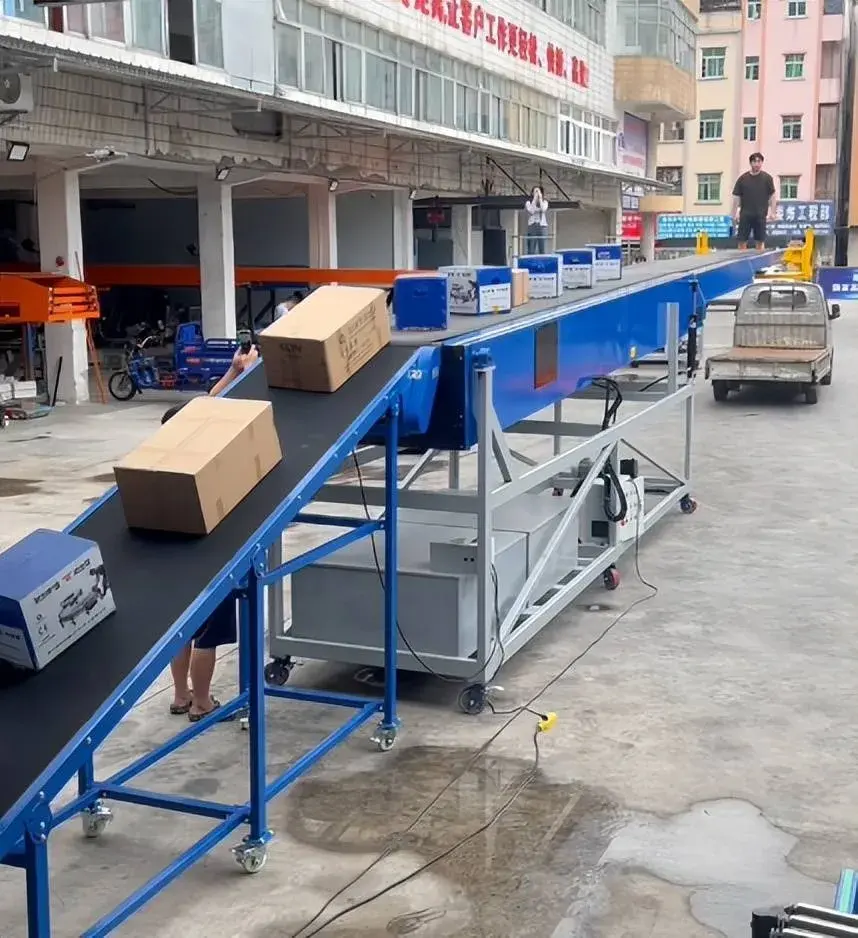
These machines use an electro-hydraulic system to provide stepless adjustment of the lifting height, enabling smooth uphill conveying from the ground into the vehicle compartment. They do not require large-scale civil construction modifications and can be put into operation as soon as on-site commissioning is complete. Common models fall into three categories: medium-duty models for box trucks of 9.6 meters and longer and standard containers; heavy-duty reinforced models for 13-18-meter high-sided flatbed trucks and heavy semi-trailers; and extended custom models that can be paired with a 15-meter telescopic roller conveyor for linked operation, making them suitable for unloading long vehicles over extended distances. The base is usually equipped with casters and lockable support legs, making it easy to switch between multiple loading and unloading points. It can also be combined with floor conveyors and roller Telescopic Conveyors to form a complete production line.
In terms of structural stability, high-quality models generally use thickened hydraulic cylinders and multi-layer oil-resistant sealing structures to reduce oil seepage and jamming during frequent lifting and lowering. The load-bearing frame is also reinforced to prevent deformation during long-term heavy-load operation.
General mixed goods and mixed-use scenarios: telescopic belt conveyors offer the broadest coverage
Among the three types of equipment, telescopic belt conveyors offer the greatest versatility. They can be used with or without a loading dock, so they are widely adopted at express delivery outlets and in small and medium-sized e-commerce warehouses. The rubber belt provides uniform friction across the contact surface, allowing it to convey standard cartons as well as reliably transfer irregular parcels, soft-packaged shipments, small furniture, and scattered irregular materials. It is suitable for high-frequency, fast-paced batch loading and unloading.
Its multi-stage telescoping structure allows the extension length to be adjusted freely, while the belt material can be selected according to requirements, including a standard wear-resistant version, a food-grade anti-slip version, or a thickened tear-resistant version. The equipment operates with low noise, and one person can complete the loading and unloading of an entire vehicle. Its internal components are highly standardized, making subsequent replacement and maintenance relatively convenient. Small warehouses with limited budgets can purchase it as a standalone unit, while large logistics parks often combine it with rollers and hydraulic uphill conveying equipment.
If a higher level of automation is required, laser tracking correction, variable-frequency speed control, and goods-sensing modules can also be added for automated express-parcel sorting lines and connection to DWS scanning and weighing equipment, thereby increasing throughput.
How to combine the three types of equipment to improve efficiency
A single type of equipment usually cannot cover all loading and unloading conditions in a warehouse. The truly practical approach is to combine equipment according to site conditions. Large manufacturing plants with standard loading docks generally use telescopic Powered Roller Conveyors as the primary equipment, supplemented by short telescopic belt conveyors for irregular mixed goods. Older factory areas without loading docks and heavy-goods loading and unloading points often use hydraulic lift-and-incline conveyors first to resolve elevation differences, then connect a roller Telescopic Conveyor at the front end to extend into the vehicle compartment. Distribution centers for express parcels, where sites with and without loading docks coexist, commonly use telescopic belt conveyors to cover general-purpose points and add powered roller Telescopic Conveyors along main routes to improve full-pallet turnover efficiency.
For small e-commerce warehouses and local delivery outlets, a single telescopic belt conveyor is often sufficient for daily loading and unloading needs. If vehicle types and heights vary significantly, adding a simple small hydraulic lifting base provides greater flexibility. Before purchasing, first assess whether a loading dock is available, the commonly used truck types, average daily loading and unloading volume, and the categories and weights of the goods. Selecting equipment according to the scenario is usually more effective than simply comparing prices.
Several issues most easily overlooked during procurement
First, do not compare only the telescoping length while ignoring the machine-body materials and rated load capacity. Low-cost equipment often uses thinner frames and rollers or belts, which are prone to deformation and breakage under long-term heavy loads. Second, do not place an order without distinguishing site conditions. Choose a roller Telescopic Conveyor first when a standard loading dock is available; without a loading dock, a hydraulic lift-and-incline conveyor must be considered, as a belt conveyor alone should not be expected to handle a large elevation difference. Third, do not overlook the ability to provide non-standard customization. Standard dimensions may not suit narrow warehouses, loading docks at special heights, or unconventional vehicle compartments. Fourth, do not ignore the manufacturer's built-in safety features. Photoelectric sensing, anti-slip protection, and emergency-stop devices have a significant impact on long-term operating costs. Fifth, do not overlook after-sales maintenance coverage. Rollers, belts, and hydraulic seals are all high-frequency wear components, and the ability to respond quickly to repairs directly affects downtime losses.
From an overall application perspective, the equipment series from Naili Unloading Artifact (Guangdong) Industrial Co., Ltd., including Naili Conveyor | Naili Conveyor, covers three types of machinery: roller, hydraulic, and belt equipment, making it suitable for applications requiring complete integrated linkage solutions. For large-group automated full-line projects, you can also compare system integrators such as Jinfengfu and Damon Technology. For light-duty belt conveyors and small sites with limited budgets, you may also consider light-equipment manufacturers such as Zhejiang Boli. For heavy-duty, fixed-position incline conveying applications in the heavy industry and mining sectors, you can refer to heavy-equipment manufacturers such as Hebei Jingge Conveying Machinery.
Overall, the key to choosing unloading equipment is not to look at the quotation first, but to first assess the loading dock conditions, vehicle dimensions, cargo characteristics, and loading and unloading frequency. Only by clarifying these factors and then selecting and combining the three types of equipment accordingly can you truly reduce labor costs, cargo damage, and waiting times.