Why Warehouse Layouts Need Gravity Skate Wheel Conveyor for Curved Routing
In a real warehouse, a conveyor line can rarely go in a straight line all the way through. Upright columns, workstations, shelving, and various infrastructure elements break a straight passage into multiple segments; if the conveyor line cannot turn, it can only take a longer route and require more handling, affecting both flow and efficiency.
By comparison, making turns with fixed conveyors usually means a heavier investment: curved sections often need customization, the installation position is fixed, and rerouting requires redesign and modification. When the turning radius is larger, it also creates hard-to-use dead space on the inside of the curve. More importantly, warehouse operations change frequently (location adjustments, seasonal fluctuations, new product routes, temporary projects, expansion, or relocation), and fixed routes are hard to keep up with quickly.
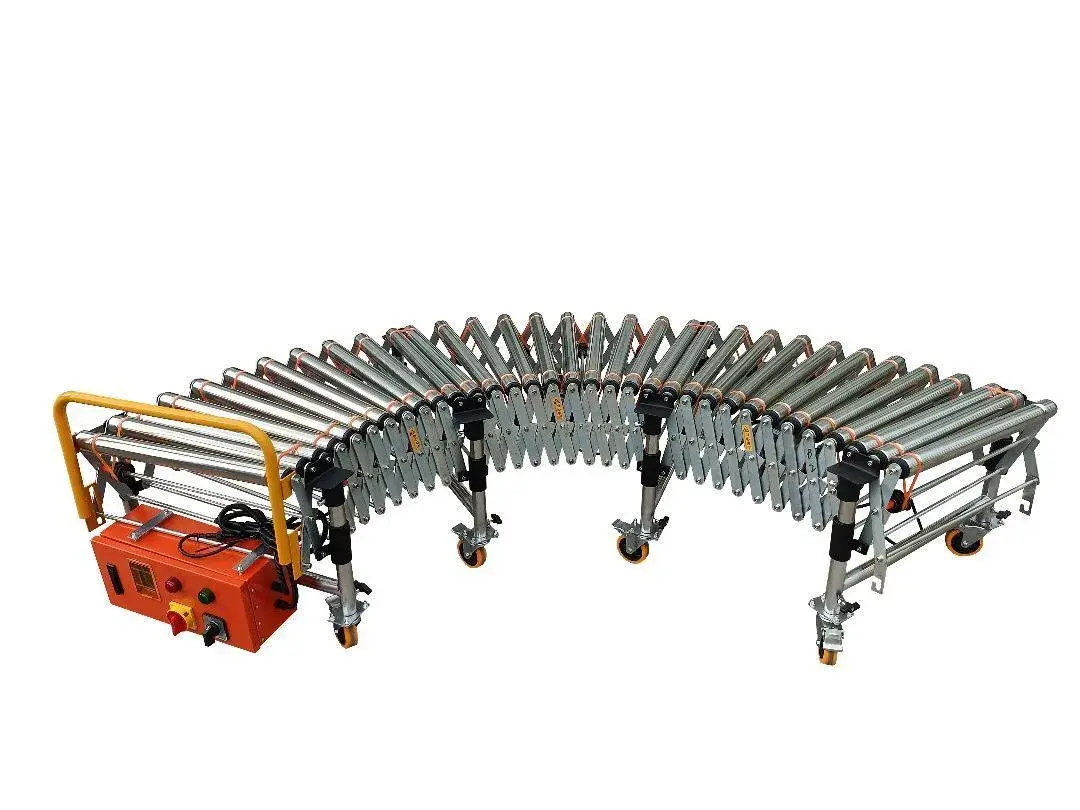
Using a Scissor Structure to Form Curves: Gravity Skate Wheel Conveyor Turns
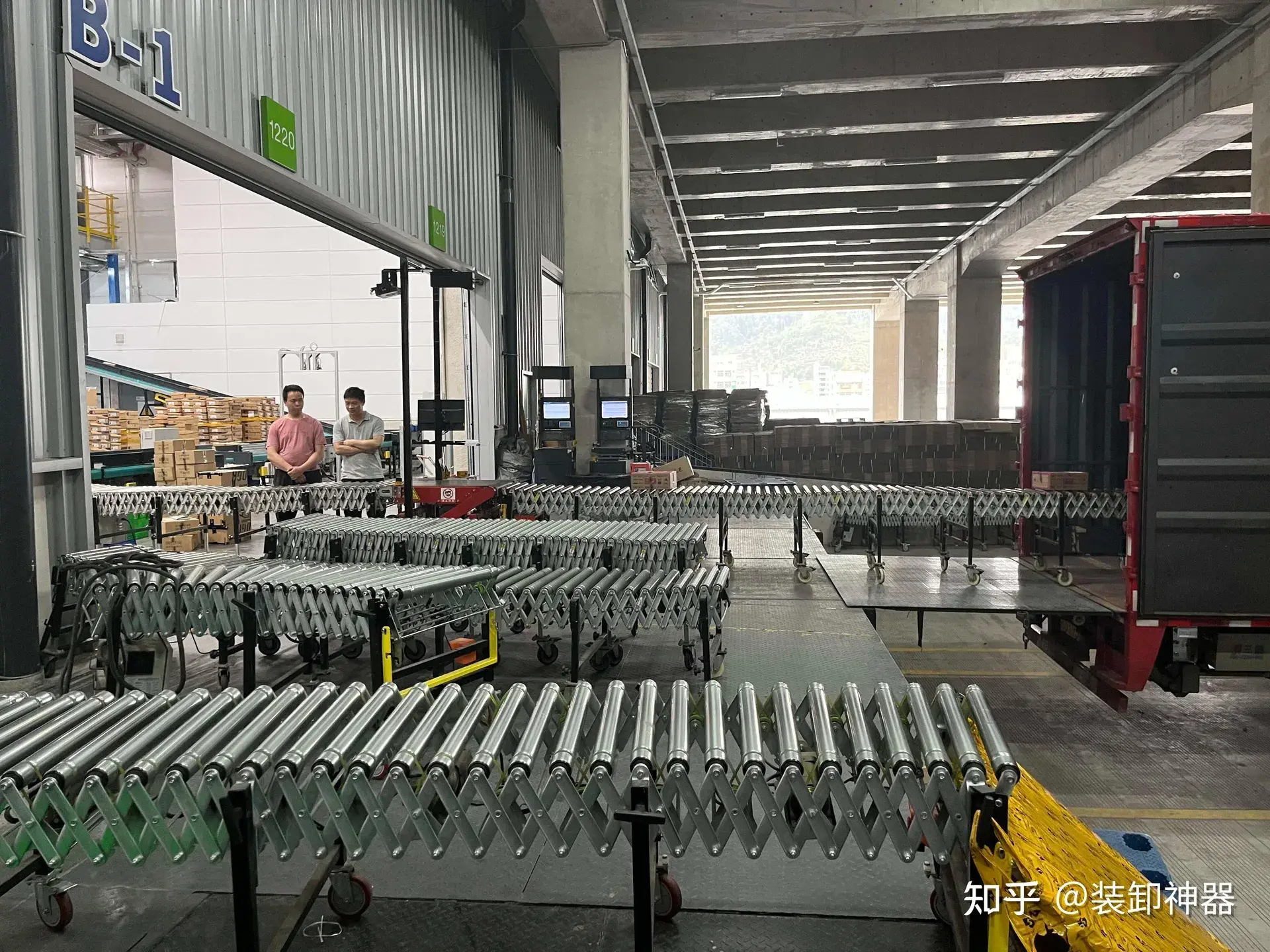
To achieve a conveyor that can turn and be rerouted, the key is a telescopic scissor-frame structure. After being extended, a non-powered telescopic roller conveyor and a Gravity Skate Wheel Conveyor can naturally form an arc by controlling the difference in extension between the inner and outer sides; with multi-section modular connections, it is possible to quickly create corners, route around obstacles, and build irregular paths.
A Gravity Skate Wheel Conveyor is usually lighter and offers a greater telescopic ratio, making it easier to create tighter turns. It is suitable for temporary or variable in-warehouse routes for lightweight parcels with flat bottoms. The video below shows an actual turning conveyor process:

Gravity Skate Wheel Conveyor
Gravity Skate Wheel Conveyor is designed specifically for bottom-flat goods such as cartons, enabling fast and efficient unloading operations. The con...
 Carton
Key Points for Building a 90° Corner: Sections, Slope, and Connection
The image below shows an on-site view of a 90° turn with a Gravity Skate Wheel Conveyor:

1) Basic Steps for Forming a Curved Section
When using a telescopic scissor structure to make a turn, on-site operation can be carried out as follows:
- First, fully extend and position a single conveyor section;
- Gradually compress the outer side of the curve while keeping the inner side relatively more extended;
- The scissor structure will naturally form a curve;
- Adjust the turning radius by changing the amount of compression on the outer side;
- Connect multiple sections in sequence to form a smoother 90° corner.
2) Approximate Number of Sections and Footprint Required for a 90° Corner (Example Range)
Different types and widths affect the difficulty of turning: the wider the conveyor and the larger the cargo, the more sections and the larger the footprint are usually required.
| Conveyor Type | Width | Sections Required for 90° | Approximate Footprint (L × W) |
|---|---|---|---|
| Gravity Skate Wheel Conveyor | 500mm | 2–3 sections | 2.5m × 2.5m |
| Gravity Skate Wheel Conveyor | 600mm | 3 sections | 3m × 3m |
| Gravity Skate Wheel Conveyor | 800mm | 3–4 sections | 3.5m × 3.5m |
| 38 mm Gravity Roller | 500mm | 3 sections | 3m × 3m |
| 38 mm Gravity Roller | 600mm | 3–4 sections | 3.5m × 3.5m |
| 38 mm Gravity Roller | 800mm | 4 sections | 4m × 4m |
| 50mm Gravity Roller Conveyor | 500mm | 3–4 sections | 3.5m × 3.5m |
| 50mm Gravity Roller Conveyor | 600mm | 4 sections | 4m × 4m |
| 50mm Gravity Roller Conveyor | 800mm | 4–5 sections | 4.5m × 4.5m |
3) Maintain flow by adjusting leg height: slope settings
For non-powered turns, keeping things moving without interruption is key; slope is one of the core variables:
- Gravity Roller Conveyor: recommended downhill slope of 2–5°
- Gravity Skate Wheel Conveyor: recommended downhill slope of 3–6°
Curved sections have greater resistance, so it is usually necessary to add about another 0.5–1° of downhill slope in the turning area as compensation. Fine-tune according to on-site cargo test results (heavy loads usually do not require a large slope, while light loads may need a greater one).
4) Transition between powered sections and non-powered curves
If the line includes both powered sections and non-powered turning sections, focus on the following at the transition points:
- Height alignment: ensure the rollers/skate wheels are at the same height
- Gap between sections: keep within 2–3mm
- Speed matching:
- Non-powered → powered: the powered section runs slightly faster
- Powered → non-powered: the powered section runs 10–15% slower
- Connection and fixing: use connecting brackets, lock the casters after positioning the conveyor, and prevent shifting during operation
- Necessary guidance and flow control: install stopper devices and guide components at critical points to improve transition stability
More complex paths and usage tips: S-curves, U-turns, and protection
S-curve: wrapping around columns and lateral offset
S-curves are often used to go around columns or achieve lateral offset, usually formed by combining two opposite arcs (add a short straight section if necessary), with a common count of 4–6 sections. Since continuous bends increase friction resistance, check whether the guidance and slope are sufficient, and make sure the curve is centered and anti-deviation measures are in place on both sides.
U-turn (180°): turning around within limited space
When a 180° turnaround is needed, a U-turn can be formed with 5–7 continuous arc sections, and the minimum inner radius should be controlled according to the cargo size; where feasible, Gravity Skate Wheel Conveyor is better suited for a more compact turnaround layout.
Anti-drop and stability: guide rails, supports, and caster locks
- Anti-drop: it is recommended to add guide rails on the outside of the curve, and on the inside if necessary
- Stability: for heavy loads or when the outside span is large, consider adding support at the midpoint on the outside of the curve
- Fixed position: be sure to lock the casters after they are in place
FAQ: Minimum turning radius reference
The minimum turning radius depends on the conveyor type, width, and cargo size, and must be verified with actual on-site cargo. Reference values are as follows:
- Gravity Skate Wheel Conveyor (500mm wide): about 1.2m
- 38mm Gravity Roller Conveyor: about 1.5m
- 50mm Gravity Roller Conveyor: about 1.8m
Further reading:
Loading and unloading fireworks with a gravity roller conveyor